Insights
What Is a Cloud Kitchen? How Ghost Kitchens Work (2026)
What is a cloud kitchen and how does it work? Ghost vs dark kitchens, business models, setup steps and how to calculate profit per delivery order.
Updated: November 27, 2026
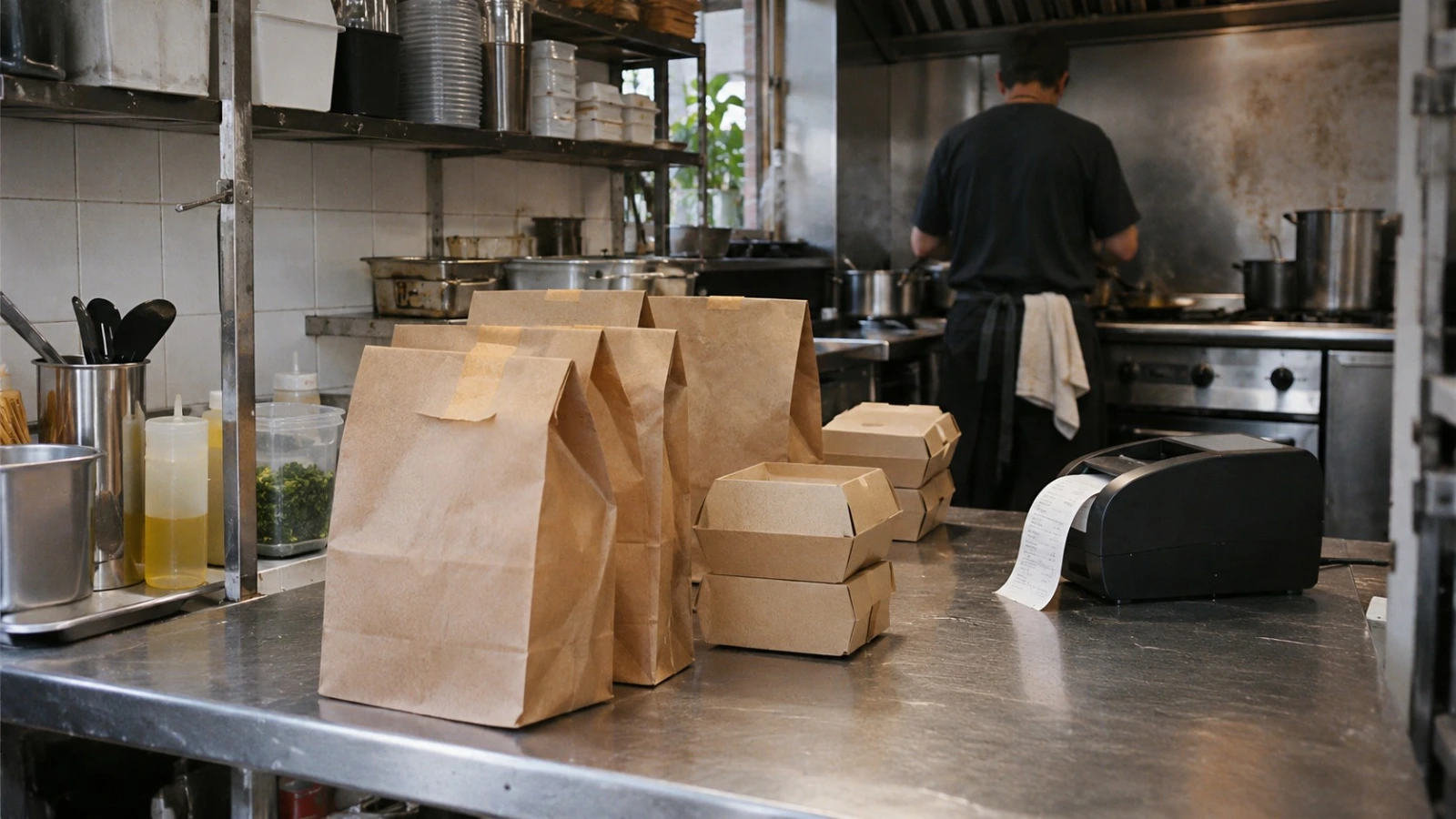
A cloud kitchen is a commercial kitchen with no dining room that cooks only for delivery and takeaway orders. Customers order through delivery apps or the brand's own website, phone line or social channels, and a courier brings the food to them. One cloud kitchen can run a single brand or several virtual brands from the same space.
This guide explains how cloud kitchens work, how they differ from ghost and dark kitchens, the main business models, what it takes to set one up and how to check whether each order actually makes money. The numbers below come from a hypothetical example business, so rerun them with your own costs.
How does a cloud kitchen work?
A traditional restaurant earns much of its revenue in the dining room, so location, décor and front-of-house staff sit at the center of the business. A cloud kitchen removes the dining room. It is usually set up in a lower-rent unit away from the high street but close to dense delivery demand, and the investment goes into the production line, packaging and order channels.
A customer finds the menu on a delivery app, the brand's web menu or social media and places an order.
The order lands on a tablet, printer or kitchen display.
The team cooks to a standard recipe card, packs the order and seals it.
A courier (the app's or the kitchen's own) picks it up and delivers it.
Payment is taken online or on delivery; app orders are paid out after commission.
Because there is no face-to-face service, the menu is the storefront. Item names, descriptions, photos and prices do all the selling, which is why menu descriptions that sell matter even more for delivery-only brands than for dine-in restaurants.
Is a cloud kitchen the same as a ghost kitchen or dark kitchen?
In everyday use, yes. "Cloud kitchen", "ghost kitchen", "dark kitchen" and "virtual kitchen" all describe delivery-only kitchens without a dining room. "Ghost kitchen" is the term most people search for in the US, while "cloud kitchen" is widely used in the Gulf and South Asia. The real differences come from the business model rather than the label:
Model | How it works | Best for | Watch out for |
|---|---|---|---|
Single-brand cloud kitchen | One brand cooks only for delivery. | Start-ups with a clear product focus | One brand's order volume must cover rent and staff. |
Multi-brand kitchen | Several virtual brands (e.g. burgers, bowls, desserts) run from one kitchen. | Teams that can build different menus from shared ingredients | Each brand needs its own menu, photos and app listings. |
Restaurant-owned virtual brand | An existing restaurant runs a delivery-only brand from its own kitchen. | Restaurants with spare kitchen capacity | Delivery orders can slow down dine-in service at peak times. |
Shared or commissary kitchen | An operator rents equipped kitchen stations to multiple brands. | Testing a concept with low upfront investment | The lease should spell out permits, hygiene and shared-area duties. |
Satellite kitchen | A chain preps in a central kitchen and finishes dishes in small local units. | Chains expanding their delivery radius | Requires a cold chain and tightly standardized recipes. |
What are the pros and cons of a cloud kitchen?
Most of the advantages come from not having a dining room: lower rent, no front-of-house fit-out or service staff, and the freedom to test and retire menus or brands quickly. In a multi-brand setup, shared stock across menus can also reduce waste.
The drawbacks come from the same place. With no street presence, visibility depends on app rankings, ratings and advertising. Commissions and courier costs take a share of every order, food quality on arrival is only partly in your control, and the customer relationship tends to stay with the app unless you build your own ordering channel.
How do you start a cloud kitchen?
Pick the area by delivery demand. Check which cuisines are busy and which are underserved within your delivery radius. Choose a site for courier access and delivery time, not foot traffic.
Design a delivery-first menu. Choose dishes that still look and taste right after a 20–30 minute trip. A short menu built on shared ingredients is faster and wastes less.
Cost every recipe. Write down portion sizes, plate cost and packaging cost for each item, and price from those cards.
Get licensed. Register as a food business and obtain the local permits your city or country requires before taking orders; requirements differ by market, so check with your local authority.
Open your order channels. List on delivery apps, but also set up a direct channel: a web menu, a phone or WhatsApp line and a QR card inside every bag that brings repeat customers back to you.
Measure and adjust. Track sales by item, cancellations, complaints, prep time and margin per order, and cut what does not sell.
To decide which dishes deserve a place on a delivery menu, the menu engineering matrix works exactly as it does for dine-in restaurants.
Is a cloud kitchen profitable?
Profitability depends on the contribution margin of each order, not on the model in general. A simple formula:
Contribution per order = net sales (excluding tax) − food cost − packaging − platform commission − delivery cost (if you pay it)
Hypothetical example: a $30 order (excluding tax) with $9 food cost and $1.20 packaging comes in through an app that charges 20% commission on that amount. Commission is $6, so the contribution is 30 − 9 − 1.20 − 6 = $13.80. The same order placed on your own web menu and delivered by your own courier for $2.50 contributes 30 − 9 − 1.20 − 2.50 = $17.30. Fixed costs such as rent, wages and marketing are paid from the total of these contributions; divide your monthly fixed costs by the average contribution per order to see how many orders you need to break even.
For the full food cost and contribution margin method, see our restaurant menu pricing guide. Raising the average order value usually comes down to well-placed pairings; our guide to restaurant upselling and cross-selling covers how to suggest drinks, sides and desserts without being pushy.
How should a cloud kitchen manage its menus across channels?
A delivery brand lists the same dishes in several places: two or three delivery apps, its own web menu, its Google Business Profile and social media. When a price or item changes, every channel has to be updated the same day, or customers will see different prices in different places. Keep one master copy of the menu and update the other channels from it.
For the direct channel, a digital menu such as Foost lets you edit items, prices, descriptions and photos in one panel and share the menu link in a QR card inside the bag, your Instagram bio and your Google Business Profile.
Cloud kitchen launch checklist
Have you checked demand and competing kitchens within your delivery radius?
Has every dish been tested after a 20–30 minute delivery?
Do you know the food, packaging and post-commission margin of every item?
Are your food business registration and local permits in place?
In a shared kitchen, does the lease state who holds the permits and who is responsible for hygiene?
Is your direct ordering channel (web menu, phone, QR card in the bag) ready?
Are you tracking item sales, cancellations and delivery times from week one?
FAQ
- What is the difference between a cloud kitchen and a ghost kitchen?
- In everyday use there is no real difference: both are delivery-only kitchens with no dining room. "Ghost kitchen" is more common in the US, "cloud kitchen" in the Gulf and South Asia. The meaningful differences come from the model, such as single-brand, multi-brand or shared kitchens.
- How does a cloud kitchen make money?
- It earns the contribution margin on each order: net sales minus food, packaging, platform commission and any delivery cost. Fixed costs like rent and wages are covered from the total of those margins, so order volume and margin per order decide profitability.
- Is a cloud kitchen cheaper to open than a restaurant?
- It usually needs less spending on rent, fit-out and service staff because there is no dining room. In exchange, commissions, packaging and marketing take a larger share of every order, so compare both models on margin per order, not just setup cost.
- Do you need a license to run a cloud kitchen?
- Yes. A cloud kitchen is a food business, so it needs food business registration and the local permits your city or country requires, just like a restaurant. Check the exact requirements with your local authority before you start taking orders.
- What food works best for a cloud kitchen?
- Dishes that travel well for 20–30 minutes, can be made quickly to a standard recipe and share ingredients with other items on the menu. Test every dish after a real delivery trip before listing it.