Insights
How to Write Menu Descriptions That Sell (2026 Guide for Restaurants)
How to write menu descriptions that help guests decide, support your prices, and give search and AI assistants text they can actually use.
Updated: November 23, 2026
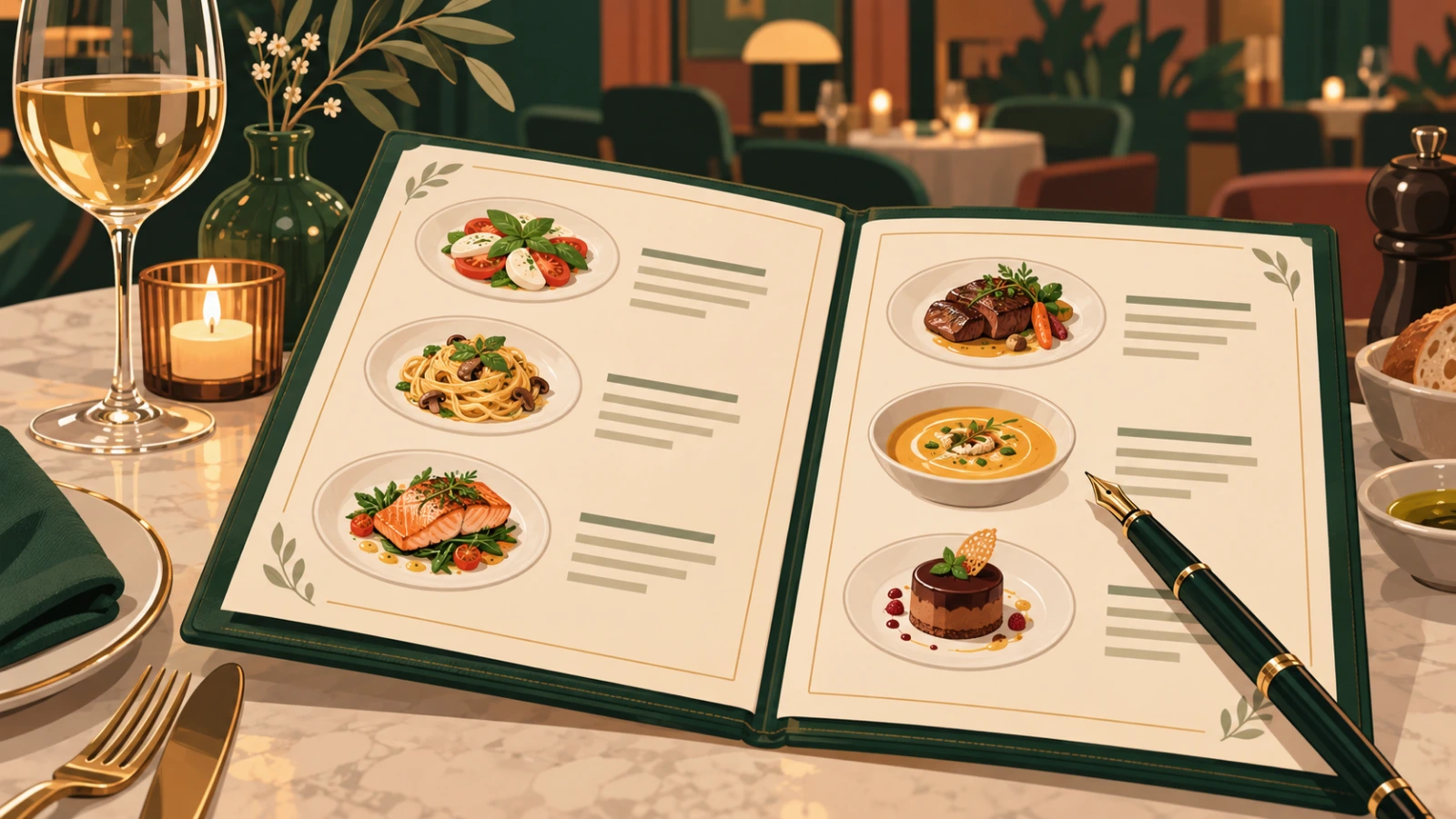
A menu description is the smallest sales pitch in your restaurant. It has two lines to help a guest choose with confidence - and increasingly, it is also the text that search engines and AI assistants read when someone asks where to eat. Yet most menus waste those two lines on words like "delicious" that say nothing.
This guide covers how to write menu descriptions that help guests decide faster, set the right expectations, support your prices, and give machines something real to work with.
What a Good Menu Description Actually Does
A description is not decoration. Done well, it does four jobs at once:
Speeds up the decision. Guests who understand a dish quickly order faster and with less hesitation - especially on QR menus, where nobody wants to scroll back and forth.
Sets expectations. A guest who reads "slow-cooked lamb shank with smoked eggplant purée" knows what will arrive. Surprises at the table are rarely good ones.
Supports the price. "Grilled chicken - 420₺" invites comparison. "Free-range chicken, marinated 24 hours in yogurt and Urfa pepper, grilled over charcoal" explains what the price buys.
Gives machines something to read. Dish names and descriptions are the clearest text a search engine or AI assistant can match to queries like "wood-fired pide near me" or "restaurant with vegan options". No text, no match.
The Anatomy of a Description That Sells
Most strong menu descriptions follow the same simple pattern: ingredient + preparation + one vivid detail.
Lead with the ingredient that matters. "Sea bass" before "with garnish". Guests scan for what the dish is, not for adjectives.
Name the preparation method. Slow-cooked, wood-fired, chargrilled, hand-rolled - these words carry texture and aroma. They also signal kitchen effort, which quietly justifies price.
Add one specific, sensory detail. Not "a delicious sauce" but "brown butter with sage". Not "fresh herbs" but "dill and purslane". Specificity is what makes a reader taste the dish in their head.
Credit the origin when it earns it. "Aegean octopus", "Gaziantep pistachios", "day-boat fish" - provenance works when it is real. Invented farm names do the opposite once a guest asks.
Words That Work and Words That Do Not
The fastest improvement most menus can make is deleting filler. Words like "delicious", "tasty", "mouth-watering" and "exquisite" describe nothing - every dish on the menu claims to be delicious, so the word carries no information. The same goes for vague superlatives: "the best kebab in town" is a claim no one believes and no one can verify.
Replace evaluation with evidence. "Delicious chocolate cake" tells the guest what to think. "72% dark chocolate, sea salt, olive oil from our own grove" lets them reach that conclusion themselves - and guests trust conclusions they reach themselves.
Keep it honest. If the "truffle" is truffle oil, say truffle oil. Exaggerated descriptions create disappointed guests and disputed bills; accurate ones create the trust that brings people back, the same principle behind clear allergen and portion information.
Length, Format and Scanability
On a phone screen, one to two short lines - roughly 10 to 25 words - is the working range. Longer descriptions get skipped; missing descriptions leave guests guessing. Aim for a consistent pattern across the menu so guests learn how to read it: dish name, then the description, then the price.
Write for scanning, not for literature. Start each description with the most important words, because guests read the first few and decide. And keep the format plain: ALL CAPS, decorative symbols and five exclamation marks make menus harder to read, not more appetizing.
Descriptions, Search and AI Visibility
Every description you publish is text that can work for you outside the dining room. Google indexes it; AI assistants extract from it when answering questions like "where can I eat vegan in Kadıköy" or "which restaurants serve gluten-free pide". A dish that only exists as a photo or inside a PDF is invisible to those systems - the same limitation we covered in our guide to PDF menus and AI visibility.
There is no formula that guarantees citations, and anyone promising one is overselling. But clear, specific, dish-level text removes the most common barrier: the machine simply has nothing to quote. Pair good descriptions with menu schema markup and you have covered both the readable and the machine-structured side.
A 20-Minute Rewrite Exercise
Pick your five best-selling dishes. These earn the most, so their descriptions matter most.
Read each description aloud. Delete every word that describes nothing: delicious, tasty, special, famous.
Add one preparation detail and one specific ingredient. Ask the kitchen if you are not sure - the detail is usually there.
Check the honesty test. Could a guest hold you to every word? If not, soften the claim or make it true.
Publish and watch. On a digital menu you can update descriptions in minutes and see over the following weeks whether those dishes move.
The Bottom Line
Menu descriptions are not copywriting for its own sake. They shorten decisions, prevent disappointment, defend your prices, and feed the search and AI systems that increasingly decide where people eat. Two honest, specific lines per dish is all it takes - and with a digital menu, rewriting them tonight costs nothing.
FAQ
- How long should a menu description be?
- One to two short lines, roughly 10 to 25 words, works best on phone screens. Guests scan rather than read, so put the most important words - the main ingredient and preparation - at the start, and keep the format consistent across the menu.
- Do menu descriptions really affect sales?
- Menu research has long associated specific, sensory descriptions with stronger ordering confidence and better recall of the meal, though exact impact varies by restaurant and no study's number transfers directly to your menu. The safer way to think about it: clear descriptions reduce hesitation and disappointment, and those effects compound.
- Should menu descriptions mention allergens?
- Brief, factual allergen information belongs on the menu, either in the description or as clear icons - guests increasingly expect it and in many markets the law requires it. Keep it factual rather than turning the description into a warning label, and make sure the information stays accurate when recipes change.
- Do menu descriptions help with Google and AI assistants?
- Indirectly, yes. Descriptions give search engines and AI systems dish-level text to index and quote when answering questions like "where can I find vegan kebab". There is no guaranteed citation formula, but dishes that exist only in photos or PDFs have no text to match at all - specific written descriptions remove that barrier.
- How often should I update menu descriptions?
- Update them whenever a dish changes - a swapped ingredient, a new supplier, a seasonal garnish. On a digital menu this takes minutes, which is one of its main advantages over print. A quick review each season keeps descriptions honest and gives regulars something new to notice.